
WILDEBEEST MIGRATION
No where in the world is there a movement of animals as immense as the wildebeest migration, over two million animals migrate from the Serengeti National Park in Tanzania to the greener pastures of Masai Mara National Reserve in Kenya during the month of July through to October. Officially The migration season starts from June to October is considered the best time of the year to visit the Masai Mara. Game viewing is optimal at this time as there is plenty of predator and prey interactions. What is the Great Migration The Great Migration is the largest herd movement of animals on the planet. In fact, with up to 1,000 animals per km², the great columns of wildebeest can be seen from space. The numbers are astonishing: over 1.6 million wildebeest and 300,000 zebra along with topi and other gazelle move in a constant cycle through the Serengeti-Mara ecosystem in search of nutritious grass and water. Guided by survival instinct, each wildebeest will cover 800 to 1,000km on its individual journey along age-old migration routes. Hungry predators including lion, leopard, cheetah, hyena, wild dog and crocs make sure only the strongest survive in this natural spectacle also known as ‘the greatest show on Earth.’ The circuit takes the animals from the Ngorongoro Conservation Area (although not into the Crater itself) in the south of the Serengeti in Tanzania, up through the Serengeti and across into the Masai Mara in Kenya and back again. The journey is beset with danger: young calves are snatched by predators, the slow are brought down by prides of lion, brave beasts break legs on steep river slopes, crocodiles take their share of the stragglers, and the weak and exhausted drown. The three groups of migrant grazers have different grass-eating habits: as one group eats the top of the tallest grass, the next group will eat away some of the medium-height grass, until finally it is almost completely eaten, and the herds move on. This means each group sticks to their own kind with only a small overlap in their distributions. The grasses of the plains have the highest protein content in the whole of the Serengeti, as well as being high in calcium. It is unclear how the wildebeest know which way to go, but it is generally believed that their journey is dictated primarily by their response to the weather; they follow the rains and the growth of new grass. While there is no scientific proof of it, some experts believe that the animals react to lightning and thunderstorms in the distance. It has even been suggested that wildebeest can locate rain more than 50km away. |-Author Asilia Africa
WILDBEEST MIGRATION SUMMARY
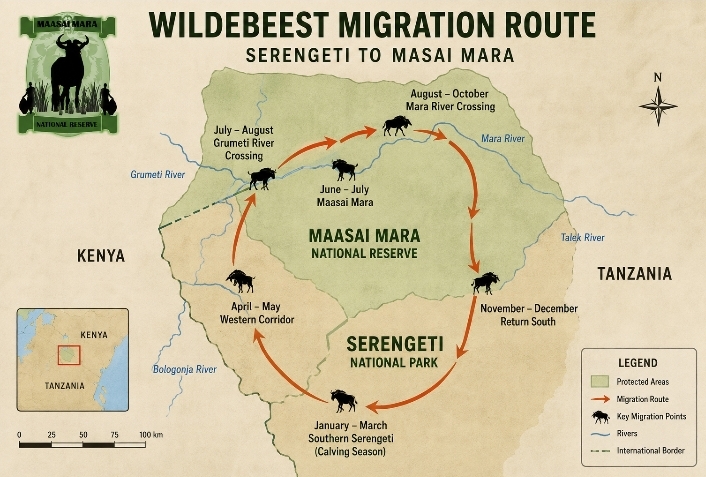
Following Nature’s Ancient Route Every year, more than 1.5 million wildebeest, accompanied by thousands of zebras and gazelles, embark on one of the greatest wildlife spectacles on Earth—a journey driven by instinct, rainfall, and the search for fresh grazing. 🌿 **Their story begins in the Southern Serengeti, Tanzania**,
where thousands of calves are born between January and March. As the grass begins to dry, the herds move north through the Western Corridor, crossing the crocodile-filled **Grumeti River** in June and July.
🐾 By **July to October**, the herds reach the legendary **Mara River**, where dramatic river crossings test their strength and survival. Those that make it across are rewarded with the lush plains of the **Maasai Mara National Reserve, Kenya**, where predators such as lions, cheetahs, and crocodiles await.
🍃 After months of grazing in the Mara, the seasonal rains signal the herds to begin their long journey south once again, returning to the Serengeti to complete the endless cycle of life.
📍 **Migration Route**
✅ January – March: Southern Serengeti (Calving Season)
✅ April – May: Western Corridor
✅ June – July: Grumeti River Crossings
✅ July – October: Mara River Crossings into Maasai Mara
✅ November – December: Return to Serengeti
✨ Witness one of the **Seven Natural Wonders of Africa** and experience nature’s greatest show at the
📞 Call / WhatsApp: **+254 780 997742**
📧 bookings@masaimaranationalreserve.co.ke
#MaasaiMara #WildebeestMigration #GreatMigration #MaraRiverCrossing #VisitKenya #MagicalKenya #SafariAdventure #NatureAtItsBest #MaasaiMaraNationalReserve
Wildebeest Migration Offers- 2026- 2027 -3days 2Nights / 4days 3nights
July- October Rates


PRIVATE SAFARIS
The Masai Mara National Reserve experiences the annual great migration of wildebeest and Zebras between July and October crossing Mara River from Serengeti Nairobi park. The Kenya Game reserve hosts a large number of wildlife species ranging from small to big mammals. Therefore it’s termed as the best place for wildlife viewing the wildebeest migration, let’s go and experience the beauty at its best…

Wildebeest Migration Offers- 2025 - 4Days 3Nights

Book your
safari